Vopak, Kinder Morgan, VTTI,Jet A-1 FOB Tank to Tank Procedure and Pricing Guide with Refinery direct Injection to Tier 1 Tanks

Large-volume Jet A-1 transactions move on documents, tanks, inspections, and timing. A price means very little unless the seller can prove allocation, the buyer can prove storage readiness, and both sides agree on the exact release and payment sequence.
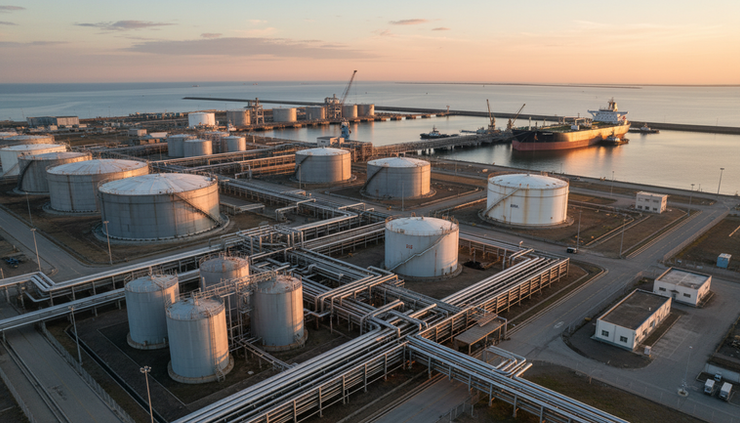
This guide breaks down the supplied FOB tank-to-tank offer terms for Jet A-1 aviation fuel, including pricing, lift volume, required documents, inspection steps, and the transaction flow into Tier 1 tank farms such as Vopak, Kinder Morgan, VTTI, or equivalent terminals in ports including Rotterdam, Houston, and Jurong.
The information below is for commercial understanding only. It is not legal, financial, trading, or compliance advice. Any buyer or seller should use qualified counsel, terminal verification, inspection agents, banking checks, and sanctions screening before entering a petroleum transaction.

The core Jet A-1 commercial terms
The offer describes a FOB tank-to-tank Jet A-1 procedure with product origin listed as Kazakhstan. The transaction is intended to move fuel from the seller’s side into the buyer’s nominated tanks at approved Tier 1 tank farms.
The stated price is:
Commercial item | Stated term |
Product | Jet A-1 aviation turbine fuel |
Price per barrel | $110 / $106 per bbl |
Trial lift | 1,000,000 bbl |
Minimum lift | 1,000,000 bbl |
Maximum lift | 5,000,000 bbl |
Commission | Buy-side $2 per bbl |
Incoterms | FOB |
Payment | T/T wire transfer and MT103 |
Origin | Kazakhstan |
Delivery method | Tank to tank injection |
Named tank farm types | Vopak, Kinder Morgan, VTTI, or Tier 1 tanks |
Named port examples | Rotterdam, Houston, Jurong |
The price line of $110 / $106 per bbl should be clarified in the Commercial Invoice or Sale and Purchase Agreement before execution. In physical oil trading, two prices may reflect gross and net figures, buyer and seller sides, or a commission-adjusted structure. No party should assume the meaning without written confirmation.
The buy-side commission is listed as $2 per barrel. On a 1,000,000 bbl trial lift, that commission equals $2,000,000 if calculated across the full lifted quantity. Because commissions can become a dispute point, the NCNDA/IMFPA should state:
The beneficiaries
The amount per barrel
The payment trigger
The paying party
The banking details
Whether commission applies to the first lift only or to all extensions
The trial lift, minimum lift, and maximum lift all point to a high-volume wholesale petroleum transaction. At this scale, small wording gaps can become large financial risks.
What FOB tank-to-tank means in practice
FOB means “Free on Board,” but in tank-to-tank transactions the practical focus is the transfer point, title transfer, and inspection sequence rather than loading directly over a vessel rail.
In this procedure, the seller is expected to inject product into the buyer’s tanks at a recognized terminal. The buyer then performs a dip test and quality and quantity inspection in the buyer’s own tank. After successful inspection, the buyer pays by wire transfer or MT103 for the value of the injected product.
This structure is attractive to buyers because it places product into their own storage before final payment. It can also protect a legitimate seller because the buyer must show credible tank storage before the seller programs injection.
The key commercial issue is control. The buyer must control real storage. The seller must control real product. The terminal, inspection company, and documents must confirm that both claims are true.
In a tank-to-tank deal, the tank is not just storage. It is part of the proof chain.
The parties and locations named in the procedure
The supplied process refers to Vopak, Kinder Morgan, VTTI, and Tier 1 tank farms. These names carry weight because large fuel transactions depend on terminals with recognized infrastructure, safety systems, documentation controls, and inspection access.
The stated port regions are:
Rotterdam
Houston
Jurong
Other approved ports with Tier 1 tank terminals
A buyer should confirm that its Tank Storage Agreement is valid for the exact product, volume, laycan, port, and terminal named in the deal. A generic storage claim is not enough. For a 1,000,000 bbl Jet A-1 lift, storage capacity, tank compatibility, and terminal acceptance must all match the proposed injection plan.

Required buyer documents before the seller acts
The procedure begins with the buyer issuing three documents or evidence items.
ICPO
The Irrevocable Corporate Purchase Order gives the seller the buyer’s formal purchase intent. It should identify the product, quantity, price, port, payment method, buyer entity, and authorized signatory.
For this offer, the ICPO should match the stated terms closely. Since the procedure says it allows no changes, any mismatch may delay or stop the transaction.
Tank Storage Agreement
The buyer must provide a Tank Storage Agreement, often stated as TSA. This is one of the most important documents in the process.
The note in the procedure says:
ATV by manager or contract Tier 1
No joint ventures
That means the seller expects storage tied directly to a qualified Tier 1 tank farm arrangement, not a vague third-party joint venture or unverified sub-storage claim. The buyer should be prepared for terminal-level verification.
Buyer passport
The process requests the buyer’s passport. In many petroleum deals, this forms part of KYC and signatory identification. Corporate buyers should handle identity documents carefully and only transmit them through secure, agreed channels. Legal counsel should review privacy, data protection, and anti-fraud controls.
Commercial Invoice and NDA signing
After the buyer submits the initial documents, the seller issues a Commercial Invoice. The buyer signs it and returns it to the seller for countersigning.
This step matters because the Commercial Invoice should lock the commercial basics:
Product name and specification
Quantity
Price per barrel
Total cargo or lift value
Port and tank farm
Payment method
Delivery basis
Inspection terms
Timing
The seller also sends a Non-Disclosure Agreement. The brief states that the NDA must be signed and sealed by the buyer and the tank farm.
That is unusual enough to deserve careful review. A terminal may not agree to sign third-party transaction NDAs unless the contract structure supports it. Before relying on this step, the buyer should confirm directly with the tank farm’s official channels that the signing format is possible.
Injection readiness and storage confirmation
The next step says the seller presents product injection to the injection tank farm and, after verification, contacts the tank farm to secure storage space.
The wording is narrow, but the commercial meaning is clear: the seller needs to confirm that product can be programmed for movement, while the buyer’s storage must be ready to receive it.
This is where many failed fuel transactions break down. The seller may claim product but lack allocation. The buyer may claim storage but lack a real tank position. The terminal may reject the schedule because no compatible slot exists.
A sound transaction should align four elements before injection:
Element | What must be clear |
Product | Jet A-1 is available and allocated |
Tank | Buyer’s storage exists and can receive the volume |
Schedule | Terminal has an available injection window |
Authority | Both parties have written authorization to proceed |
Injection Programming Agreement
The seller then issues an Injection Programming Agreement, or IPA. The buyer and the buyer’s tank farm company sign it.
The IPA should describe how the fuel will move into the buyer’s tank. It should match the tank farm’s operational requirements and should not conflict with the TSA.
A useful IPA normally covers:
Injection date or window
Product grade
Quantity to be injected
Tank number or storage reference
Terminal or port
Safety and operational requirements
Inspection access
Responsibility for fees and delays
Notice of Readiness timing
If the IPA is vague, the injection step becomes hard to verify. For a transaction of 1,000,000 to 5,000,000 bbl, operational precision is essential.

Product allocation documents issued by the seller
Once the IPA stage is complete, the seller transfers product allocation documents to the buyer. The listed documents are central to the Jet A1 FOB tank to tank procedure and pricing guide because they connect commercial terms to physical proof.
Product Passport
The Product Passport identifies the product and its quality characteristics. For Jet A-1, this should align with the relevant aviation turbine fuel specification required by the buyer and destination market.
Certificate of Origin
The Certificate of Origin states the origin of the product. In this case, the offer lists Kazakhstan. Buyers should check origin rules, sanctions exposure, customs requirements, and import restrictions for the destination country.
Authorization to Sell and Collect
The Authorization to Sell and Collect, listed as ATSC, is meant to show that the seller has authority to sell the allocated product and collect payment.
This document should be checked against the seller entity, refinery relationship, allocation holder, and banking records.
Unconditional Dip Test Authorization
The Unconditional Dip Test Authorization, or UTDA, gives the buyer permission to inspect the product. In the supplied process, this inspection happens in the buyer’s own tanks after injection begins or completes.
The word “unconditional” is important. Any restriction on inspection access should be reviewed before the buyer signs.
Injection schedule and Notice of Readiness
The injection schedule and NOR confirm when the product is ready for transfer. The Notice of Readiness should identify when the seller and terminal are prepared to begin injection into the buyer’s tank for the agreed spot lift quantity.
Dip test, SGS inspection, and injection report
The procedure states that the buyer conducts a dip test, and the seller commences injection. After that, the seller releases:
Injection Report
Recent SGS Quality Survey
The buyer then proceeds with inspection of the product with an SGS agent in the buyer’s own tanks. SGS is a widely known inspection company in commodity trading, but buyers should confirm the appointment directly and ensure the inspection instruction is valid.
The buyer’s inspection should address both Q&Q:
Inspection area | Purpose |
Quality | Confirms product matches agreed Jet A-1 specification |
Quantity | Confirms injected volume in the buyer’s tank |
Tank measurement | Confirms level, density, temperature, and volume calculations |
Sampling | Supports lab testing and retained sample records |
The strongest point of this structure is that payment follows inspection in the buyer’s own tank. That reduces exposure to paper-only product claims, but it does not remove all risk. The buyer still needs to verify the tank agreement, terminal communications, seller authority, and document chain before any binding step.
Payment by T/T wire transfer and MT103
After successful Q&Q dip test, the buyer pays for the total value of the product injected into the tanks by T/T wire transfer or MT103.
An MT103 is a SWIFT payment message used to confirm an international wire transfer. It is not a substitute for received funds. The seller should verify cleared funds through its bank, and the buyer should only transmit payment according to the signed contract and verified banking instructions.
At 1,000,000 bbl, the gross value at $110 per bbl would be $110,000,000. At $106 per bbl, it would be $106,000,000. Those figures show why banking verification is not a formality. Any change in account details, beneficiary name, or payment route should trigger a pause and written re-confirmation through known secure channels.
Title transfer and intermediary payment
After payment, the seller releases the product title, ownership title, and ownership documents to the buyer. The seller then pays all intermediaries according to the signed NCNDA/IMFPA.
This final step should be tied to clear contractual language. The buyer needs documents that prove ownership and allow lawful control, resale, lifting, or onward movement. Intermediaries need a signed commission agreement that leaves no question about who pays, when payment is due, and what barrels are commissionable.
A clean closing file should include:
Countersigned Commercial Invoice
Signed NDA if required
Signed TSA confirmation
Signed IPA
Product Passport
Certificate of Origin
ATSC
UTDA
Injection schedule
NOR
Injection Report
SGS quality and quantity documents
Proof of payment
Title and ownership transfer documents
NCNDA/IMFPA commission record
Practical checks before accepting the procedure
The supplied instructions state that the refinery-direct procedure is fixed and does not allow changes. If that is the case, the buyer’s main protection is not negotiation. It is verification before signing.
Before proceeding, a buyer should confirm:
The seller is legally authorized to sell the product
The refinery or allocation source can be verified
The tank farm recognizes the buyer’s storage agreement
The terminal can accept the proposed injection schedule
The product documents are internally consistent
The inspection company appointment is real
The payment account matches the contracted seller
Origin and routing pass compliance checks
The commission structure is documented
The title transfer documents are sufficient for onward use
A seller should also protect itself by checking that the buyer has real storage, real funds, and authority to contract.
The main takeaway
A Jet A-1 FOB tank-to-tank deal is not just a price quote. It is a chain of proof from ICPO and TSA through injection, inspection, payment, and title transfer.
The stated offer gives clear headline terms: Jet A-1 at $110 / $106 per bbl, Kazakhstan origin, FOB tank-to-tank delivery, 1,000,000 bbl trial lift, up to 5,000,000 bbl maximum, payment by T/T or MT103, and a $2 per bbl buy-side commission.
The safest way to handle the procedure is to treat every step as a verification point. If the storage is real, the product is allocated, the inspection is independent, and the title documents match the payment, the transaction has a workable structure. If any link is unclear, pause before moving to the next step.


Comments